The
1960s
A decade of increasing independence during which a strategy
of vertical integration and horizontal diversification
in the product range is adopted.
1961
Nuclear Developments Ltd is formed. It is a consortium
of the Company, Rolls-Royce and Rio Tinto formed to manufacture
nuclear fuel elements.
1962
Metals Division and its subsidiaries (excluding the aluminium
interests) will henceforth be  grouped
within a new holding company, Imperial Metal Industries.
The operating company will be Imperial Metal Industries
(Kynoch) Ltd. The fifteen-year process of disengagement
from ICI has started.
grouped
within a new holding company, Imperial Metal Industries.
The operating company will be Imperial Metal Industries
(Kynoch) Ltd. The fifteen-year process of disengagement
from ICI has started.
At this time IMI (Kynoch) is the largest UK producer of
copper and copper alloy semis, particularly sheet. In
rod and section Delta is the main competitor. In strip,
Ratcliff (Great Bridge) is the major supplier. Profitability
is inadequate, partly due to the large, ICI-like overhead
structure and partly to under-utilisation of capacity.
The New Metals business, recently a major contributor
to profits, is about to suffer a severe downturn. In Ammunition
and Metal Fabrication profits are negligible due to depressed
prices and high costs.
A large electron beam furnace is on order intended for refractory metals such as niobium and tantalum.
J. F. Ratcliff (Metals), a Birmingham manufacturer of
copper and brass sheet and strip, is acquired.
intended for refractory metals such as niobium and tantalum.
J. F. Ratcliff (Metals), a Birmingham manufacturer of
copper and brass sheet and strip, is acquired.
A commemorative book marking the Company's 100th anniversary
is published by The Kynoch Press - "Under Five Flags"
(which have now become six). The author, who is unacknowledged
at the time, is Dorothy Thomas, an employee.
1963
Imperial Metal Services is formed. Its purpose is to acquire
shares and other interests in companies dealing in metals.
Henry Righton (a merchant of copper semis) is acquired
for £1m. A small stake is taken in Range Boilers.
Talks about future cooperation are held with BICC but
no attractive case for a merger of interests appears.
This is the end of moves towards horizontal integration
for some years.
1964
In a drive towards rationalisation and greater 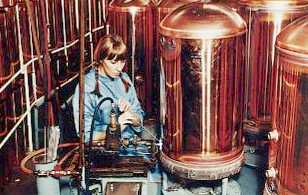 efficiency,
Steatite and Porcelain is sold to Morgan Crucible Ltd.
and the Elliott Works at Selly Oak is also disposed of.
Opti Group and Lightning Fasteners are in talks about
future cooperation which will lead to a merging of their
interests in the following year. Range Boilers (right)
and the Company enter a cooperative arrangement. The Company
takes advertising space to clarify the position regarding
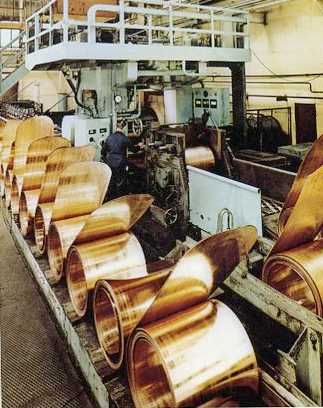
high copper prices and supply shortages. The modernised
strip mill at Witton (below) is formally
opened. A 29% stake is taken in Wolverhampton Metal (Holdings).
efficiency,
Steatite and Porcelain is sold to Morgan Crucible Ltd.
and the Elliott Works at Selly Oak is also disposed of.
Opti Group and Lightning Fasteners are in talks about
future cooperation which will lead to a merging of their
interests in the following year. Range Boilers (right)
and the Company enter a cooperative arrangement. The Company
takes advertising space to clarify the position regarding
high copper prices and supply shortages. The modernised
strip mill at Witton (below) is formally
opened. A 29% stake is taken in Wolverhampton Metal (Holdings).
 1965
A new facility to manufacture waterproof sporting ammunition
- an important innovation - is opened by a former chairman,
Dr. Beeching. The Company is the world's biggest exporter
of sporting ammunition with 40% of its output going abroad,
this year 38,400,000 cartridges. Powder and Shot,
a documentary about gun construction and markmanship,
made by the ICI Film Unit for the Company, is issued.
1965
A new facility to manufacture waterproof sporting ammunition
- an important innovation - is opened by a former chairman,
Dr. Beeching. The Company is the world's biggest exporter
of sporting ammunition with 40% of its output going abroad,
this year 38,400,000 cartridges. Powder and Shot,
a documentary about gun construction and markmanship,
made by the ICI Film Unit for the Company, is issued.
A
merger occurs between Lightning Fasteners and the Opti
Group. YKK, a serious Japanese competitor, opens its first
European factory in Holland.
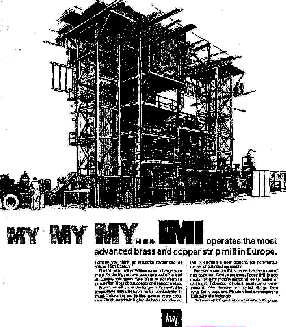
A successful bid is made to acquire Range Boilers. This
move coincides with a spate of company prestige advertising:
"My My My....IMI".
1966 IMI becomes a public company: an issue of
Imperial Metals Industries Loan Stock is announced and
of 10m. Ordinary Shares. ICI still holds 89.6% of the
stock but this is widely seen as a move by ICI to grant
its subsidiary greater independence. The equity offer
is heavily oversubscribed.
John Wilkinson and Sons (Saltley), makers of copper alloy
strip and wire, is acquired together with its subsidiary
Headley, Birch & Co. Santon Ltd of Newport (electric
water heaters) is also acquired. Annual profits are £6.4m
1967
The titanium interests of Jessop-Saville, Sheffield, are
to be acquired. 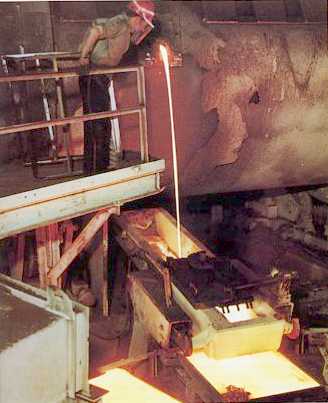 The
remainder of the equity in Wolverhampton Metal (Holdings)
comprising James Bridge Copper Works (left)
and Wolverhampton Metal Co. (both metal refiners) is also
bought. The move from paper to plastic sporting cartridge
cases is to be speeded up, to about 75% of the total of
the 100 different types manufactured. Amongst the latter
Tenex target ammunition sales now amount to 20m. units
a year. A new extrusion press in the Rod Mill is commissioned.
Company turnover is £77m. yielding a profit of £4.7m.
The
remainder of the equity in Wolverhampton Metal (Holdings)
comprising James Bridge Copper Works (left)
and Wolverhampton Metal Co. (both metal refiners) is also
bought. The move from paper to plastic sporting cartridge
cases is to be speeded up, to about 75% of the total of
the 100 different types manufactured. Amongst the latter
Tenex target ammunition sales now amount to 20m. units
a year. A new extrusion press in the Rod Mill is commissioned.
Company turnover is £77m. yielding a profit of £4.7m.
Dead Safe, a film on safety in shooting, is issued.
1968
An offer is made to buy Yorkshire Copper (Holdings), the
Company's partner in ownership of Yorkshire Imperial Metals
and is accepted. 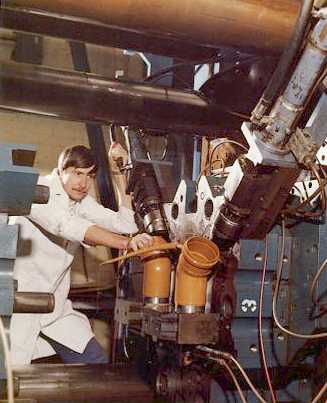 The
Company launches a domestic tap made of plastic under
the trade name Opella. Yorkshire Imperial Plastics
starts to market an underground pvc drainage pipe (right,
in 1975). Rolls-Royce's Lockheed Airbus contract
is likely to lead to sales of 1500 tons of titanium. Much
new plant is commissioned: a high speed rolling mill for
copper and brass foil; new melting and casting facilities
for the strip and sheet mills; and a new liquid-metal-cooled
vacuum melting furnace for titanium. Turnover is £168m.
The
Company launches a domestic tap made of plastic under
the trade name Opella. Yorkshire Imperial Plastics
starts to market an underground pvc drainage pipe (right,
in 1975). Rolls-Royce's Lockheed Airbus contract
is likely to lead to sales of 1500 tons of titanium. Much
new plant is commissioned: a high speed rolling mill for
copper and brass foil; new melting and casting facilities
for the strip and sheet mills; and a new liquid-metal-cooled
vacuum melting furnace for titanium. Turnover is £168m.
1969
A 51% stake is acquired in
Paxman Cooler Manufacturing Co. of Brighouse (beverage
cooling and dispensing). An unsuccessful bid is made for
Enots, Lichfield (pneumatic control equipment). The Company
is in 78th place in a list of top British industrial companies
based on capital employed. In response to a survey the
Company states that the number of employees earning more
than £10k p.a. is "about 10". Henry Righton & Co.,
the Group's metal stockholding company, announces that
henceforth its pricing will be based on decimal currency
and metric measurements. A new company, I.M.I. Australia
Ltd., is formed to manage and expand the Company's metal
and ammunition interests in that country. Courtaulds and
ICI agree to cooperate in the field of composite materials;
Imperial Metal Industries will be involved.
Because of the issue of new shares to support acquisitions,
ICI's stake in the Company has now dropped to 65%
The
1970s
An unhappy decade with British industrial relations plumbing
new depths and foreign competition increasing but with
the Company obtaining full independence again after 60
years and still actively investing in new plant, continuing
to diversify into new product areas and establishing a
completely new business area of great future significance.
The advertising slogan is "IMI means more than metal".
1970
A new titanium rolling mill is ordered
for Waunarlwydd. Compression Joints Ltd. of Weston is
acquired. 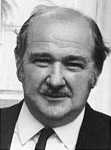 The
Company commits itself to a multi-million pound expansion
of titanium capacity once Concorde reaches its performance
targets. The Company's Managing Director, St.John H. Elstub
(left),
is knighted. G. Brammall (Tungsten) is acquired as is
Clix Fastener Corporation of Montreal. Rolls-Royce collapses
but the Company consoles itself by putting the cost at
no more than £1.5m, borne mainly by IMI Titanium and Marston.
Winfield Metals, a small strip manufacturer is acquired;
but capital expenditure dwindles and IMI's Chairman publicly
questions for the first time the future of the UK semis
market.
The
Company commits itself to a multi-million pound expansion
of titanium capacity once Concorde reaches its performance
targets. The Company's Managing Director, St.John H. Elstub
(left),
is knighted. G. Brammall (Tungsten) is acquired as is
Clix Fastener Corporation of Montreal. Rolls-Royce collapses
but the Company consoles itself by putting the cost at
no more than £1.5m, borne mainly by IMI Titanium and Marston.
Winfield Metals, a small strip manufacturer is acquired;
but capital expenditure dwindles and IMI's Chairman publicly
questions for the first time the future of the UK semis
market.
1971
The national engineering workers'
strike against the Industrial Relations Bill closes Kynoch
Works for a day. After poor results Enots agrees to a
reduced bid from the Company. The quest for innovative
new products leads to the Company finding itself managing
a Scottish oyster hatchery. Profits are £14.17m helped
by cost cutting measures including a 1000 reduction in
staffing levels.
1972
350 maintenance workers strike over
a pay claim affecting the entire Witton site. The Company
is not alone: most of the British car industry is in chaos
due to industrial action. Builders' and miners' strikes
also affect the Company's activities.
Nevertheless innovation and acquisition continue. Marston
Radiators collaborate with two European firms to produce
the newly developed aluminium car radiator. The Company
has developed a revolutionary new lightweight domestic
boiler. IMI Engineering Plastics is created at Witton
to handle the design and production of new fibre-reinforced
materials. A surprise offer is made for Norgren Shipston
International and its US associate, C.A. Norgren (pneumatic
equipment). Muntz Plastics, Wrexham (plastic pipes and
fittings) is bought.
It is expected that IMI Titanium's sales will recover
from the Rolls-Royce disaster to a level equivalent to
that for 1970.
1973
Inflation is running at 24%. For
the Company, it is a year of disasters. Two Rolls-Royce
RB211 Tristar engines fail in flight. The cause is traced
to front fan discs manufactured from IMI Titanium forgings.
Investigation work is urgent and detailed and business
is affected. Even worse, an electric drill being used
by a maintenance engineer on a contaminated explosives
loading machine sparks off a major explosion at Witton
in the sporting ammunition area. Six
people lose their lives
and a further fifteen are injured, one seriously. A question
is asked in Parliament and at the inquest the Company
is criticised.
The Company forms with Olin Corp. a joint venture company,
Marstolin, to market coated titanium anodes for chlorine
and similar applications. Mecafrance (valves) is acquired
Turnover is £275m giving a profit of £14.9m.
1974
The country suffers from the chaos
of the three-day week resulting from industrial action
by the miners. The Company says that it is maintaining
output at 85% with the help of in-house generating capacity.
Witton is not immune from the general industrial anarchy.
On October 7th a strike over pay by 1000 craftsmen starts.
Production workers strike over layoffs caused by the strike.
On November 9th the craftsmen agree to resume work. Production
has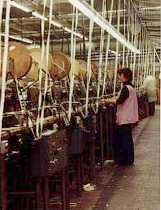 been halted in the meantime and 5000 other employees laid
off. (10,000 are also idle at British Leyland). The strike
has cost the Company about £3m. YIM's performance causes
concern, affected by the poor industrial relations situation
at Kirkby. Trading conditions are in any case difficult
especially in building and textiles: 190 Lightning Fasteners
workers (left)
will lose their jobs because of Japanese competition and
the price of copper peaks at a level three times higher
than that of three years previously.
been halted in the meantime and 5000 other employees laid
off. (10,000 are also idle at British Leyland). The strike
has cost the Company about £3m. YIM's performance causes
concern, affected by the poor industrial relations situation
at Kirkby. Trading conditions are in any case difficult
especially in building and textiles: 190 Lightning Fasteners
workers (left)
will lose their jobs because of Japanese competition and
the price of copper peaks at a level three times higher
than that of three years previously.
Plans are announced for further expansion of the building
products area of activity in various plants throughout
the country. The Company agrees to buy the fine tube interests
of Serck Ltd.
Top Brass is released, a film showing how non-ferrous
rod and wire are produced.
1975
The Company protests at Japanese
dumping of fasteners. The adverse effect on business is
increasing. IMI Impala is sold. The Board considers a
proposal that due to all the difficulties of operating
in the UK 70% of all future acquisitions should be overseas.
"A drab and dispiriting year".
1976
A rights issue is announced, mainly
to finance a stake in a new Iranian copper semi-finished
products factory. This latter project however fails to
come to fruition. UK acquisitions will be made with the
aim of reducing dependence on copper-based activities.
The Company is operating a waste-burning boiler within
its 50mw power station. A protest is made at unfair Japanese
price-cutting of titanium products and the high tariff
wall protecting their suppliers. Against
the background of industrial turmoil in the West Midlands
a decision is made to move the IMI Opella operation off
the Witton site to the calmer waters of Hereford; despite
violent opposition this move eventually occurs.
1977
The Evening Mail contains
a blank column where a report on the Company's results
should have appeared, N.G.A. representatives having refused
to handle the information since it has been received by
telephone rather than the N.G.A. member manned teleprinter.
The Company buys Mapegaz-Remati, France (industrial valves).
IMI Valves International is formed to spearhead the growing
industrial valve activity. Exploratory talks with Delta
Enfield with the aim of rationalising rolled metals manufacture
and investment come to nothing. ICI sells off its 63%
stake in Imperial Metal Industries and the Company is
now independent for the first time since 1918.
1978
As
the Company relishes its independence and looks forward
to the future, it has 27,000 employees in the U.K., plus
a further 6000 overseas. 44% of its equity is owned by
private shareholders including many employees and pensioners.
Samuel Birkett, Yorkshire, (specialist
valves) is acquired as well as a majority stake in Whittaker
Hall (compressors and pumps). It is alleged that the 1974
Japanese commitment to reduce the export of YKK fasteners
to the U.K. has not been honoured. 40% of the market is
now in Japanese hands.
1979
The Company changes its name to
IMI. The "Imperial" tag is no longer appropriate
and the abandonment of "Metal", which no longer
accurately describes the company, is part of a strategy
to expand overseas
and into products with a higher added-value content.
overseas
and into products with a higher added-value content.
The possibility of cooperation with Delta is again thwarted.
The Kynoch Press is sold.
A new group is formed, IMI Drinks Dispense, comprising
Paxman and Redditch Controls and a new company is
established with Cornelius, USA. These moves are intended
to allow greater exploitation of the potental market for
drink dispensing equipment and are highly significant
as far as the Company's future is concerned.
IMI Norgren Shipston receives the Queen's Award for Export
Achievement (right).
The
1980s
In this decade which starts with a serious trade recession,
not helped by a lengthy strike in the steel industry,
the Company will move towards higher margin finished products
such as pipe, tubes and fittings and develop those new
areas of business on which its future will eventually
prove to depend. The traditional "metal-bashing" activities
will decline.
There is now clearer definition of the Company's main
activities. They fall currently within seven product groups:
Refined and Wrought Metals (the metal refining and forming
activities); Zip Fasteners; General Engineering (Yorkshire
Imperial Alloys, Eley, IMI Components etc.); Special Purpose
Valves (Mapegaz, Mecafrance, IMI Bailey Valves, Samuel
Birkett, CCI etc.); Heat Exchange (IMI Marston, IMI Radiators
etc. and initially the drinks dispense activities); Building
Products (YIM, YIP, etc); Fluid Power (Enots, Norgren
etc.); and, from 1982, Drinks Dispense (Cornelius, Paxman,
Redditch Controls etc.)
1980
Two workers are killed at the Summerfield rocket research
station, operated by the Company.
Company sales are down by 5% overall. IMI Titanium announces
a multi-million pound expansion at Witton (melting and
forging) and in South Wales (rolling). The performance
of the Kirkby tube factory has improved significantly
and further major investment is sanctioned. But the Board
declines to make further investment in more modern rolling
mills and so the fate of IMI Rolled Products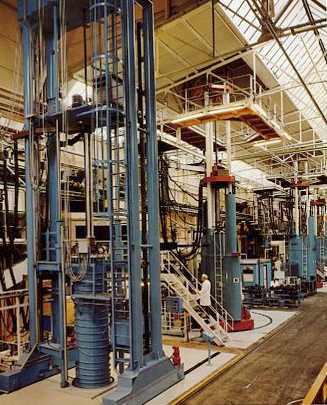 is effectively sealed. The manufacture of copper semis
is in any case dwindling and now represents only a small
part of the Company's activity. IMI Rod and Wire is sold
to McKechnie.
is effectively sealed. The manufacture of copper semis
is in any case dwindling and now represents only a small
part of the Company's activity. IMI Rod and Wire is sold
to McKechnie.
The decline in the zip fastener business leads the Company
to write off its equity interest, although the activity
does of course continue. IMI Components and Eley are contracting.
IMI Titanium (right)
is having a second very difficult year with a collapse
in demand. But the Drinks Dispense business is thriving
and the Fluid Power activities show signs of recovery.
One
in seven of the Company's 24,500 employees lose their
jobs this year due to the general slump and the need for
cost cutting.
Collaboration between the Company and BTR is discussed
and the latter take a 25% stake in IMI Marston whilst
their Palmer Aero Products business is acquired and relocated
to Wolverhampton; Marston's name is changed, temporarily,
to Marston Palmer.
1981
The recession continues to bite
and total sales are down by a further 10%. IMI Enots,
IMI Norgren Shipston and IMI Pneumatics are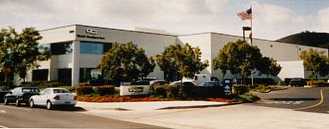 merged into a single company, IMI Norgren Enots. Control
Components International of California (control valves)
is bought (shown
right in 1986).
About 40% of the Company's production is now carried out
abroad and of the UK production 20% is exported. It is
still felt that further independence from the U.K. economy
is needed.
merged into a single company, IMI Norgren Enots. Control
Components International of California (control valves)
is bought (shown
right in 1986).
About 40% of the Company's production is now carried out
abroad and of the UK production 20% is exported. It is
still felt that further independence from the U.K. economy
is needed.
Princess Margaret visits Witton in December.
1982
The dividend to shareholders is
reduced. The whole of Cornelius is acquired and becomes
IMI Cornelius. In two years IMI has become one of the
world's largest suppliers of drinks dispensing equipment.
1983
There is launched a collaborative scheme between IMI and
Birmingham City Council and using half of IMI's 228 acre
Witton site to provide an eventual 2m. sq.ft. of industrial
space in modern buildings. Turnover is £676m. and profit
£31m. £20m. has been spent over the last four years on
reorganisation and redundancy. IMI's employees now total
15,485, just 60% of the level four years previously.
1984 Development of the Holford
site begins which will lead to the creation of an award
winning industrial estate. Not everything being swept
away will be a dismal industrial 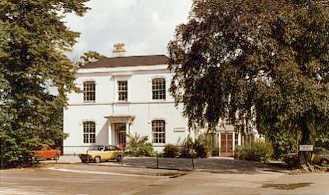 landscape:
it will include the more picturesque corner occupied by
Holford House (left).
landscape:
it will include the more picturesque corner occupied by
Holford House (left).
Drinks Dispense is contributing 30% of the profits from
only 15% of the turnover. Fluid Power is also doing well.
Elkington Copper Refiners of Walsall is acquired and the
activity absorbed into James Bridge Works. There is a
management buyout of IMI Wilkinson and J. F. Ratcliff
(Metals). Rolled Metals is now the Company's only copper
and brass semi activity at Kynoch Works and represents
a mere 3% of turnover. BTR and IMI merge their radiator
service and distribution businesses under the name International
Radiator Services. Pactrol Electronics (energy saving
controls) is acquired. Eley ammunition accounts for 15
out of a possible 24 medals at the Los Angeles Olympics.
1985
Henry Righton & Co. is sold
to Granges. Sales of rolled metals fall by 10%. The new
product area of Drinks Dispense is faltering slightly
this year but Fluid Power and Special Purpose Valves show
improved profit. The titanium business is performing well;
provisional agreement is reached whereby Sumitomo of Japan
will take a 50% stake in IMI Titanium but is shelved when
profitability declines. Discussions also occur with US
manufacturers with the aim of licensing IMI's technology
but again these come to nothing. Yorkshire Imperial Plastics
is experiencing difficult trading conditions and the Wrexham
factory closes. IMI Marstair expands and following its
acquisition of I.S. Air Conditioning becomes IMI Air Conditioning.
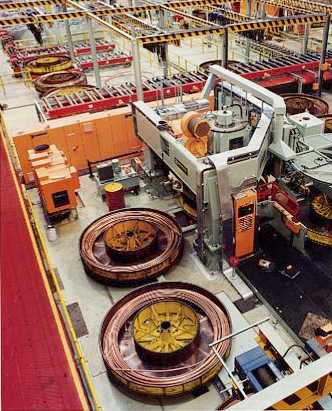
The precision diecasting activity of IMI Components is
an early occupant of premises on the new Holford trading
estate. A second phase is sanctioned.
1986
Martonair
International is acquired at a cost of £88m, the
biggest acquisition to date. This transforms IMI's Fluid
Power Group into
one of the world's largest manufacturers of pneumatic
equipment, matching the Company's position in the field
of drinks dispensing. The acquisition of Webber
Electro Components plc (pneumatic
solenoids) and, next year, of the Swedish AB Westin &
Backlund's pneumatic division will further strengthen
this area of activity. Coldflow (drinks dispensing equipment)
is purchased and added to the Drinks Dispense group of
companies.
Significant further investment in the tube business at
Kirkby (right)
is sanctioned and the capillary fittings business of Glynwed
Tubes and Fittings is acquired.
233,000 sq.ft. of space on the Holford trading estate
(a
glimpse of whose future is shown below)
have been let. 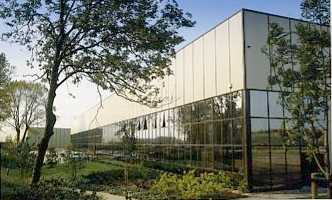
Formed in 1983, IMI Computing (software and technical
services) is now making a significant contribution to
company profitability.
1987
The Company's structure is adjusted
with each of the groups becoming the responsibility of
a specific director and being based more on market and
business areas than on products. Fluid Control now includes
valves and the heat exchange activities are grouped within
Special Engineering (formerly General Engineering) whilst
alloy tube becomes part of Refined and Wrought Metals.
The seven groups have now become five.
The company disposes of its 60% interest in Anderson Greenwood
(Australia) Pty. Ltd., its 50% holding in Silverton Engineering
Holdings (Pty.) Ltd. of South Africa (automotive radiators
and number plates), and, after a declining 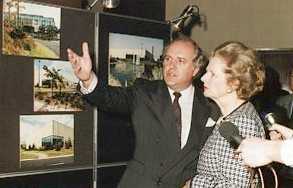 performance,
its share of Mapegaz-Remati S.A. Ownership of IMI Summerfield,
which IMI is contracted to manage, passes from Royal Ordinance
to British Aeropace. Hayes Metals is sold.
performance,
its share of Mapegaz-Remati S.A. Ownership of IMI Summerfield,
which IMI is contracted to manage, passes from Royal Ordinance
to British Aeropace. Hayes Metals is sold.
The Prime Minister, Margaret Thatcher, visits Witton.
1988
CEDISA of Spain (valves and cylinders) and Martonair Belgium
are added to Fluid Power. Lintra
Lineartransporter of Stuttgart (rodless cylinders) is
also acquired as well as another manufacturer of similar
products, C&C Manufacturing of Illinois. Various distribution
companies in Europe and elsewhere are
acquired at around this time.
IMI Mouldings, which includes the Opella operation, is
sold.
Also sold is Yorkshire Imperial Plastics in the
Building Group; to the latter are however added this year
R. Woeste of Germany and Raccord Orleanais of France (both
copper fittings), in line with the strategy to make this
business more European based.
Specialised
Engineering is strengthened by a major acquisition, that
of the Conax Buffalo Corporation (temperature sensors).
Marston's
flexible fuel tank business is sold.
The 40-year
arrangement by which the Company manages the Summerfield
rocket motor establishment is terminated.
Eley
and IMI Titanium are both recipients of the Queen's Award
for Technological Achievement.
1989
During
this period Drinks Dispense is enjoying good business
in Europe but the situation is less happy in North America.
Attempts to improve this include the concentration of
Cornelius's component production in a single plant at
San Antonio, Texas and the reaching of a world-wide supply
agreement with Coca-Cola. In
the Americas the Company now has manufacturing plants
in Brazil and Canada, in addition to the USA and several
European countries. Markets for drinks dispense products
are being developed also in China, Taiwan, the Philippines
and Indonesia. Similar progress is being made by the Cannon
service equipment group and several acquisitions are made
in this period, including Cumberland Corporation, (mobile
merchandising carts and milk cases). In this year Cannon
obtains its first contract for an automated cold storage
system for dairy products for a major UK supermarket chain.
In Refined and Wrought Metals, IMI Titanium is performing
well. The acquisition of TiTech International (titanium
castings) gives it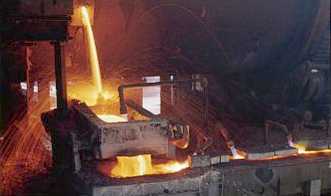 a long-sought presence in North America. In the rest of
the Group, the emphasis is not on growth but on the most
effective use of the asset base as, in the case of IMI
Rolled Metals, Yorkshire Imperial Alloys and possibly
the refining companies (right),
the business declines.
a long-sought presence in North America. In the rest of
the Group, the emphasis is not on growth but on the most
effective use of the asset base as, in the case of IMI
Rolled Metals, Yorkshire Imperial Alloys and possibly
the refining companies (right),
the business declines.
Special Engineering sees this year a major disposal, that
of IMI Radiators to Nippondenso.
In the Building Group IMI Pacific of France (cylinders)
is disposed of.
Holford Estates continues to progress well: 640,000sq.ft.
has been built or reserved and over 1350 jobs created.
Its book value is put at £18.7m.
Sales reach £1bn. for the first time.
The
1990s
This decade will see initially a return to recession for
the first three years, followed by a recovery for the
rest of period. It will be marked for the Company by significant
restructuring and an acceleration in corporate activity;
and it will witness the final departure from the traditional
metal smelting, metal founding and construction-related
business as expansion of the newer core businesses gathers
momentum.
 1990
IMI decides to abandon the rolled metals industry. In
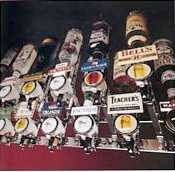
Drinks Dispense, MK Refrigeration Group (drinks cooling
equipment and
optics- see right) and Conveyor Speciality
Systems of Minnesota (material handling
equipment), later renamed Cannon Conveyor Systems, are
acquired as well as two small distributors in Greece and
Italy. Brook Street Computers is purchased .
1990
IMI decides to abandon the rolled metals industry. In
Drinks Dispense, MK Refrigeration Group (drinks cooling
equipment and
optics- see right) and Conveyor Speciality
Systems of Minnesota (material handling
equipment), later renamed Cannon Conveyor Systems, are
acquired as well as two small distributors in Greece and
Italy. Brook Street Computers is purchased .
1991
IMI Rolled Metals is closed and plant sold off.
The closure process takes much of the year and runs smoothly,
a tribute to good industrial relations and cooperation.
Thus ends the Company's association with an activity which
dates back to 1877 and has involved thousands of Birmingham
working people over 114 years.
IMI buys the Birmingham Mint Ltd. of Icknield Street.
The IMI Birmingham Mint Ltd. is formed and all minting
operations are transferred from Kynoch Works to Icknield
Street. The Company also acquires A.W. Cash Valve, an
American producer of heating and plumbing controls, and
Remcor Products of Chicago (ice/drink combination machines);
the latter acquisition brings a strengthening of Drinks
Dispense Group's association with Coca Cola. IMI Titanium's
profitability slumps dramatically due to market conditions
as does that of Yorkshire Imperial Alloys, a situation
from which the latter will not recover.
Redwood International (software) is acquired, bringing
IMI 's annual computing sales up to £50m.
1992
The Building Products group continues
to decline, being hit especially hard this year, its sales
reducing for the third consecutive year, from £404 million
in 1989 to £305 million with a corresponding hit on profits.
IMI's Special Engineering profits also decline dramatically.
The Refined and Wrought Metals Group disappears and the
remaining businesses now fall under Special Engineering
and Building Products. Walter AG, Switzerland's leading
manufacturer of valves, cylinders and air service units
is acquired to strengthen Fluid Power.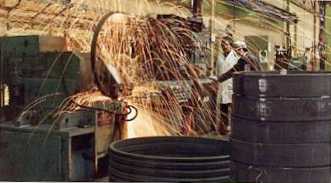 But the trading difficulties faced by that group force
a move towards the rationalisation of its worldwide manufacturing
operations: thirty locations will in due course be reduced
to twelve. Marston's aircraft engine ring business (left)
is sold to an American competitor.
But the trading difficulties faced by that group force
a move towards the rationalisation of its worldwide manufacturing
operations: thirty locations will in due course be reduced
to twelve. Marston's aircraft engine ring business (left)
is sold to an American competitor.
1993
The Company's four main areas of activity continue to
be: Building Products, Fluid Power, Drinks Dispense and
Special Engineering.
Fluid Power's profitability dips this year, prior to significant
improvement in the following years as the effect of restructuring
is felt. Within the Building Group however the performance
is sharply improved following major investment in the
tube and refining activities. Contrary to previous policy
the Board now decides to consider the possibility of acquiring
a plastics activity.
In Drinks Dispense, Cornelius is appointed a preferred
supplier to Coca Cola. Relationships with Pepsi are however
not soured and a strategic alliance will be agreed between
the two companies early next year.
The performance of Specialised Engineering is adversely
affected by IMI Titanium's problems in a difficult market
and the Company opens discussions with Timet of the USA
about possible cooperation. Casino Tokens Inc. of Las
Vegas is acquired to supplement the minting operation.
 1994
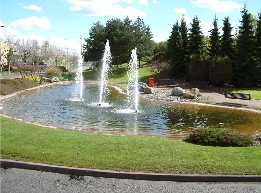
37 acres of surplus land at Witton is sold, as well as
Phase 1 of the Holford Industrial Estate (right)
which nets £24m. Brook Street Computers and Redwood
International are sold following operating losses. IMI
Range and IMI Stanton merge. Andrews Water Heaters is
bought. Within Specialised Engineering, IMI Titanium's
losses double to £7m. despite a 30% increase in
sales. Yorkshire Imperial Alloys is also having difficulties,
faced with similar problems: international over-capacity
and uncompetitive plant and equipment.
1994
37 acres of surplus land at Witton is sold, as well as
Phase 1 of the Holford Industrial Estate (right)
which nets £24m. Brook Street Computers and Redwood
International are sold following operating losses. IMI
Range and IMI Stanton merge. Andrews Water Heaters is
bought. Within Specialised Engineering, IMI Titanium's
losses double to £7m. despite a 30% increase in
sales. Yorkshire Imperial Alloys is also having difficulties,
faced with similar problems: international over-capacity
and uncompetitive plant and equipment.
1995
There is a major reorganisation of IMI Titanium involving
substantial redundancies which returns the activity to
profit and the discussions with Timet about a possible
joint venture reach a satisfactory conclusion. It is announced
that the Company's titanium interests are to be merged
with those of Tremont Corp. of the U.S.A., the owner of
Timet, giving IMI a 38% stake in the new company. The
possible disposal of Yorkshire Imperial Alloys is actively
pursued. Elsewhere in the Specialised Engineering Group,
special purpose valves and IMI Components are doing well.
In Building Products, IMI Waterheating, a merger of Santon
and Range, is having trading difficulties and a decision
is made to close two factories. Similar difficulties at
IMI Cash Valve (formerly A.W. Cash Valve)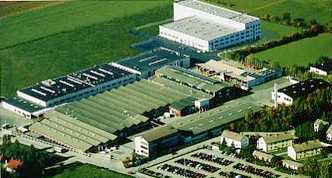 lead to a transfer of the business from Illinois to Alabama.
There are also
lead to a transfer of the business from Illinois to Alabama.
There are also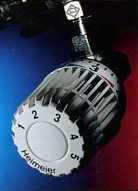 significant site configuration changes in the French,
Belgian and Hungarian operations. In September is announced
the Company's biggest ever (£134m.) acquisition,
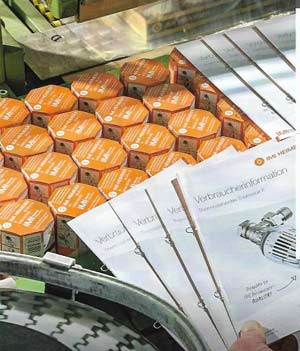
that of Heimeier, the largest manufacturer of thermostatic
radiator valves in Germany (whose Erwitte factory
is shown above and typical product right).
significant site configuration changes in the French,
Belgian and Hungarian operations. In September is announced
the Company's biggest ever (£134m.) acquisition,
that of Heimeier, the largest manufacturer of thermostatic
radiator valves in Germany (whose Erwitte factory
is shown above and typical product right).
Bar-Master International (bar valve dispense equipment)
is added to Drinks Dispense.
1996
In February the Timet transaction is completed. In April
the Company seizes an opportunity to sell its holding
in Timet and thus at £105m. completes its withdrawal
from titanium on better terms than might previously been
envisaged. Almost the whole of the titanium interests
are sold, as is IMI Computing, the subject of a management
buy-out. Purchases include the American businesses of
Mosier (pneumatic actuators) and ISI Automation (pneumatic
components - £84m.) which are added to the Fluid
Power group. A wholly new factory is commissioned in China
to manufacture drinks dispense equipment and Objex Ltd.
(countermount displays) is acquired. 50% of IMI's employees
are now resident outside the U.K.
1997
The policy of divesting non-core businesses continues.
Conax Buffalo is sold (£4.4m.) After unsuccessful
attempts at disposal IMI Yorkshire Alloys is closed following
 unacceptable
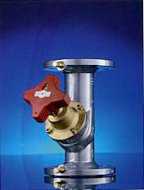
losses. There are more acquisitions: TA Hydronics of Sweden
(hydronic balancing valves - £93m. - see left) and
Herion, Germany (hydraulic components - £39m.),
both for Fluid Power; and Sulzer's industrial valve division,
Thermtec, for Specialised Engineering. A decision is made
to rationalise the global manufacturing facilities of
Drinks Dispense: this will result in manufacturing units
reducing from 20 to 14 and a new factory to manufacture
beer coolers at Brighouse where Paxman had started to
make them thirty years earlier.
unacceptable
losses. There are more acquisitions: TA Hydronics of Sweden
(hydronic balancing valves - £93m. - see left) and
Herion, Germany (hydraulic components - £39m.),
both for Fluid Power; and Sulzer's industrial valve division,
Thermtec, for Specialised Engineering. A decision is made
to rationalise the global manufacturing facilities of
Drinks Dispense: this will result in manufacturing units
reducing from 20 to 14 and a new factory to manufacture
beer coolers at Brighouse where Paxman had started to
make them thirty years earlier.
The 30% stake in International Radiator Services, formed
with BTR in 1984, is sold.
1998
The disposal of those businesses which have no obvious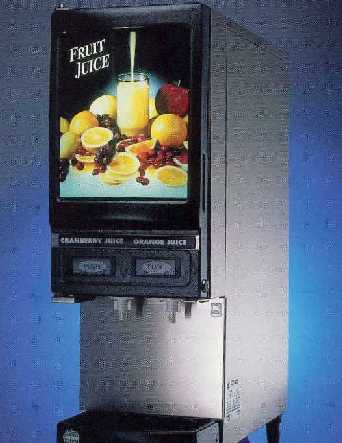 place in the Company's strategy continues: the Birmingham
Mint Group (£18m.), IMI Waterheating (£20m.),
IMI Pactrol (£10m.), Marston's industrial heat exchanger
business (£21m.), IMI Precision Diecastings and
IMI Reeves. Wilshire Corporation of Illinois (air conditioning
and refrigeration - see right) is acquired for Drinks
Dispense and supplements Cornelius's activities; and KIP
Inc. of Connecticut (solenoid valves - £18m.) for
Fluid Power. The four main areas of activity remain but
as the activities become more concentrated Building Products
is now known as Hydronic Controls and Specialised Engineering
as Energy Controls, reflecting its increasing focus.
place in the Company's strategy continues: the Birmingham
Mint Group (£18m.), IMI Waterheating (£20m.),
IMI Pactrol (£10m.), Marston's industrial heat exchanger
business (£21m.), IMI Precision Diecastings and
IMI Reeves. Wilshire Corporation of Illinois (air conditioning
and refrigeration - see right) is acquired for Drinks
Dispense and supplements Cornelius's activities; and KIP
Inc. of Connecticut (solenoid valves - £18m.) for
Fluid Power. The four main areas of activity remain but
as the activities become more concentrated Building Products
is now known as Hydronic Controls and Specialised Engineering
as Energy Controls, reflecting its increasing focus.
 1999
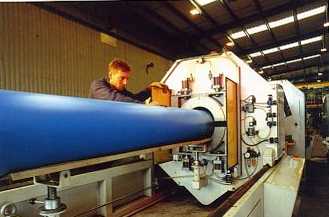
A view on the increasing trend in the European building
sector towards plastics and away from traditional materials
leads to the purchase (£350m.) of Polypipe, a manufacturer
of plastic drainage products (left). This
trend also threatens other companies in the Hydronics
Controls Group and all of them are operating under generally
difficult trading conditions. The refining activities
are badly hit by this and by new environmental regulations
and the Company feels compelled to withdraw from all activities
in that area apart from billet casting, a move which leads
to extensive redundancies.
1999
A view on the increasing trend in the European building
sector towards plastics and away from traditional materials
leads to the purchase (£350m.) of Polypipe, a manufacturer
of plastic drainage products (left). This
trend also threatens other companies in the Hydronics
Controls Group and all of them are operating under generally
difficult trading conditions. The refining activities
are badly hit by this and by new environmental regulations
and the Company feels compelled to withdraw from all activities
in that area apart from billet casting, a move which leads
to extensive redundancies.
Drinks Dispense acquires a US company, Jet Spray, which
takes the Company into hot drink dispensing for the first
time and opens new areas of business opportunity. Also
acquired is Melrose Displays Inc. of New Jersey (point-of-purchase
displays- £4.9m.)
The last of Marston's major activities, its aerospace
interests, are finally sold to a US company, Hamilton
Standard, a United Technologies subsidiary (£16.6m.)
and the new company is called HS Marston. Just two small
activities remain: heat sinks which will later be absorbed
into HS Marston and bursting discs which will become part
of IMI Safety Systems. And so the Company's almost eighty
year association with Marston - whose own roots in Midlands
industry are even deeper than those of Kynoch and stretch
back to 1740 - is severed.
Energy Controls now comprises exclusively controls companies
with the exception of the Witton based nuclear components
and ammunition operations.
The
2000s
An even greater concentration on what are seen as the
Company's core businesses will be seen in this decade.
Almost every "traditional" business will disappear and
the Company will be transformed beyond recognition.
2000
A detailed review of the Company's businesses is in hand.
Employees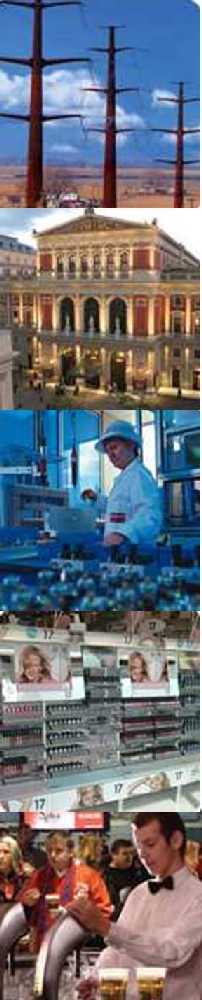 now total 19,000 worldwide. Flow Controls Inc., USA is
acquired.
now total 19,000 worldwide. Flow Controls Inc., USA is
acquired.
2001
The Company's future strategy is revealed. Concentration
will be on the business areas of Fluid Controls and Retail
Dispense which provide five discrete business segments
serving large, market-leading customers.
The Fluid Controls businesses operate in the area of power
generation and oil and gas (Severe Service); essential
pneumatic systems for automotive, medical and other outlets
(Fluid Power); and energy conservation and personal comfort
in buildings (Indoor Climate).
The Retail Dispense businesses service major drinks producers
and retailers (Drinks Dispense); and producers and retailers
of other branded items at point of display (Merchandising
Systems).
The Company is moving into high value, knowledge based
engineering and systems based-solutions. The cost base
will be reduced and some manufacture will be outsourced
or moved to low cost areas of the world including Mexico,
China and Eastern Europe. 30% of existing manufacture
will be affected over the next two years. Manufacturing
capacity in China is doubled. Two new facilities are created
in Mexico.
Various traditional businesses in the old Building Products
Group have no place in this new strategy.
2002
The Copper Fittings and Copper Tube businesses are sold.
The Eley ammunition business is sold too, the activity
out of which the company has grown, which has survived
for almost a century and a half and to which the origins
of the newer businesses can all be traced. Cartridge manufacture
will move to Minworth.
Acquisitions include STI Milan and DCI Milwaukee (point-of-sale
services).
The streamlining of administration costs has led to job
losses and a significant reduction in people costs.
The remainder of the Witton site is sold for redevelopment
but IMI's Severe Service business will stay on the site,
in leased premises.
A new history of the Company is published: "A World
of Engineering - The Story of IMI 1862- 2001" by
Ewan Fraser and John Metcalf.
2003
Artform International Ltd., Loughborough (a point-of-sale
equipment provider), Commtech, U.K., (indoor climate commissioning
and servicing) and Fluid Kinetics, California (industrial
silencers) are acquired.
In April the Kynoch Works site is vacated after 141 years.
The new IMI Headquarters is an office block at Lakeside,
on the Birmingham Business Park at Solihull and convenient
for the airport.
2005
Polypipe is sold. This disposal marks the end of the portfolio
repositioning announced in 2001 and the Company has now
been transformed to a greater extent than at any other
time in its long history. The aim is announced of raising
the proportion of total production in low cost economies
from the present 25% to 40%. Company turnover is now £1.3bn.
The present location of the approx. 14,000 employees is
as follows: UK - 2700, Europe - 5000,
Americas - 5300, Asia - 1000 and Elsewhere - 100.
2006
Truflo, a US manufacturer of pumps, is acquired in April
(£113m) and becomes part of the Fluid Controls Group.
The Company's residual responsibility for the copper fittings
business, sold in 2002, leads to its liability for a European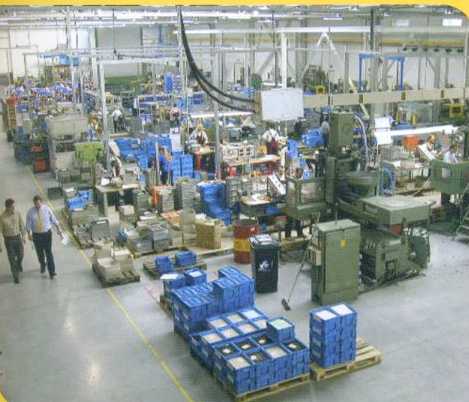 Commission fine of 48.3m. euros against which it appeals.
New products include new control valve and strainer products
for the natural gas and nuclear industries; a
device to protect agains legionella in cooling systems;
and merchandising products for Microsoft's new Zune music
and digital player. The trend towards increased manufacture
in lower cost economies continues. The
Company's newest overseas facility, the Cornelius plant
in the Ukraine, begins production this year. Major operational
locations are now: Austria, China, Czech Republic
(see
right, Norgren's Brno plant),
Germany, Italy, Japan, Mexico, South Korea, Sweden, Switzerland,
UK, Ukraine and USA.
Commission fine of 48.3m. euros against which it appeals.
New products include new control valve and strainer products
for the natural gas and nuclear industries; a
device to protect agains legionella in cooling systems;
and merchandising products for Microsoft's new Zune music
and digital player. The trend towards increased manufacture
in lower cost economies continues. The
Company's newest overseas facility, the Cornelius plant
in the Ukraine, begins production this year. Major operational
locations are now: Austria, China, Czech Republic
(see
right, Norgren's Brno plant),
Germany, Italy, Japan, Mexico, South Korea, Sweden, Switzerland,
UK, Ukraine and USA.
Within the Fluid Controls group, the key businesses are:
CCI, Truf lo Rona and Orton (Severe Service); Norgren
(Fluid Power); and TA, Heimeier and FDI (Indoor Climate).
Within Retail Dispense they are: Cornelius and 3Wire (Beverage
Dispense); and Cannon, DCI Marketing, Artform and Display
Technologies (Merchandising Systems).
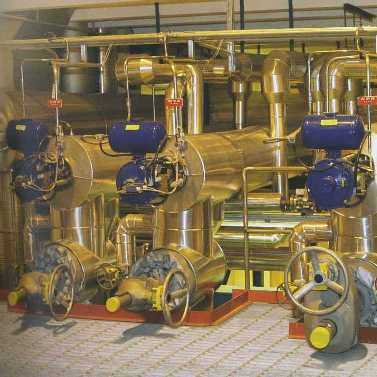 2007
2007
The company grows by nearly 7% and
achieves revenue of £1,599m. and an increase in
profitability of 10%. 14700 people are directly employed
throughout the world. The overall strategy - focus on
leading customers in niche markets to whom bespoke and
innovative solutions can be provided and whose growth
the Company can share, reinforced by effective account
management and after-sales service - is unchanged and
continues to be pursued vigorously.
Kloehn (specialist fluid handling systems in the life
science sector - £30m.) and Pneumatex (water conditioning
equipment - £19m.) are acquired this year.
The trend towards the transfer of more manufacturing facilities
to lower cost economies continues. The manufacturing operation
for merchandising equipment in China has trebled and that
for Fluid Power 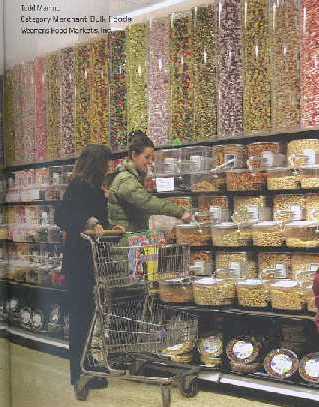 in
Mexico doubled.
in
Mexico doubled.
These are the business areas:
- Severe Service (CCI, Orton, Truflo Rona, Newman Hattersley)
- £362m., 2400 people (above
right)
- Fluid Power (Norgren) - £571m., 6000 people
- Indoor Climate (TA, Heimeier, FDI, Pneumatex) - £207m.,
2000 people
- Beverage Dispense (Cornelius, 3Wire) - £285m., 2500
people
- Merchandising (Artform, Cannon, DCI, DT) - £174m.,
1400 people
(right)
Innovative new products this year include actuator and
valve controls for nuclear power plants; door operating
systems for Siemens high speed trains; climate control
systems for Terminal 5; new, energy-efficient refrigeration
equipment for drinks dispensing; a new cold beer station
for Coors; and new LED lighting advances for cosmetics
merchandising.
2008
The Company continues to demonstrate progress: sales are significantly increased and profits modestly so. Evidence of innovation is also apparent. Sales of new products introduced over the previous three years account for around one-seventh of turnover. Significant introductions include new wellhead gas production chokes, several new valve types for the life sciences sector, and 'Viper', a new frozen beverage dispenser. The year sees the completion of a three-year programme to transfer a greater proportion of production capacity to low cost economies. By the end of the year the global recession is starting to make itself felt generally on the Company's business and with particular effect on those parts of the Company dependent on the automotive, commercial vehicle, construction and soft drinks bottling industries.
2009
The early part of the year sees the need for significant retrenchment in the face of the downturn. The global workforce is reduced by about 17% (2600 people) and extensive short-time working introduced. Further production capacity is moved out of Europe and North America. A new Fluid Power facility is opened in Shanghai and rapid progress is made on two new Severe Service facilities, at Brno and Chennai. The current manufacturing activity in low-cost countries is likely to increase from 35% of the total to about 50% over the next 2/3 years. All these measures, together with significant investment in emerging markets and new product development, ensure a continuing healthy financial position for the Company despite all the difficulties in the marketplace. Successful new products include a new high performance differential pressure control valve for large cooling systems and district heating systems (Indoor Climate) and an integrated pneumatic system to control gas in anaesthesia ventilators (Fluid Power). The prospects for 2010 are marginally improved.
2010
Demand in many of the Company's markets has increased and the financial results indicate a strong performance. The Company's concentration is on maintaining technology leadership in the precise control of fluids in critical applications; market leadership in global niches populated by large successful customers; and high exposure to key global trends driving economic growth.
In the Severe Service valve business the new manufacturing facility in the Czech Republic opens in May and its sister facility in India is also operational; the Oil & Gas and LNG sectors are recovering strongly whilst business in the Fossil Power and Nuclear sectors are quiet; agreement is reached to create a new venture to supply control valves into the China nuclear industry.
The Fluid Power business is busy in its five key global sectors -- Commercial Vehicles, Life Sciences, Rail, Energy and Food & Beverage; manufacturing continues to be transferred to the Company's low-cost facilities in China, the Czech Republic, Brazil and Mexico.
The Indoor Climate business returns to growth; the engineering and sales resource is being expanded, especially in the emerging markets and North America.
In Beverage Dispense recovery is also continuing; the strongest markets are the Americas and China; new product development targets the higher growth water, juice, frozen drinks and smoothies markets; demand for the new more energy-efficient coolers is also growing.
In the Merchandising business some growth is also seen, especially in the automotive sector; plans are in hand to open a new "In-Vision" Centre in the USA to explain the science of merchandising to customers and demonstrate how the Company can add greater value for them.
2011
Further improvements in performance are seen, greatly assisted by the Company's market leading technology in many of its global niche markets.
The Severe Service valve business shows growth assisted by the results of the newly acquired Zimmerman & Jansen and TH Jansen; the acquisition of Remosa sPa and Grupo InterAtiva in Brazil strengthen isolation valve capabilities.
In Fluid Power manufacturing continues to be transferred to low cost sites in China, the Czech Republic and Mexico.
The Indoor Climate business currently relies significantly on refurbishment projects, reflecting the subdued new construction market in Europe; investment continues to be made in educating the market to help drive demand and some 83,000 customers attend one of the Company's seminars, especially in North America, Germany and China; a new range of balancing and control valves is being developed and centres have opened to demonstrate hydronic control involving the recruitment of 50 more hydronic sales engineers.
The strongest markets for Beverage Dispense is the Americas; several major new product development opportunities have been identified.
In Merchandising a large automotive project is completed and that sector shows signs of improvement with dealers once again investing in their showrooms; the InVision retail science laboratory is opened in Milwaukee, USA: this state-of-the-art facility enables customers to see how the Company can assist them to further their own business.
2012
There is another encouraging financial performance with a small overall growth and an improvement in operating margins. The company's strategy is to concentrate on areas where its fluid technologies can best be used in global market niches leading to a leadership position and heightened exposure to long-term trends of climate change, resource scarcity, urbanisation and an ageing population.
The logic of this strategy leads to the conclusion that the majority of the Merchandising business should be divested and options are being explored. A part of this business which offers certain synergies is transferred to the Beverage Dispense activity.
The Severe Service valve business grows especially in Fossil Power and Oil & Gas, as does Merchandising.
Fluid Power, Indoor Climate and Beverage Dispense all have a more difficult year with overall revenues flat or declining slightly but with an overall improvement in profitability.
This is a summary of the current Company activities, on the 150th anniversary of the day when a young George Kynoch trundled a shed on rollers from central Birmingham to establish his percussion cap business in the hamlet of Witton:
SEVERE SERVICE
Activity: highly engineered valves and controls, used in critical applications and extreme operating environments, enabling vital industrial and energy production processes to operate safely, cleanly and more efficiently.
Key brands: CCI, BTG, IMI Nuclear, Orton, Truflo Rona, STI, Z&J, THJ, Remosa, InterAtiva.
Main markets: fossil power; nuclear power; liquefied natural gas; iron and steel; petrochemical and refining.
Major operational locations: Belgium, Brazil, China, Czech Republic, Germany, Italy, Japan, South Korea, Sweden, Switzerland, UK and USA.
Employees: 4350
FLUID POWER
Activity: specialists in motion and fluid control technologies, both pneumatic and electric, custom engineered for critical applications requiring precision, speed and reliability.
Key brands: Norgren, FAS, Kloehn, Herion, Buschjost, Maxseal
Main markets: commercial vehicles; food and beverage; life sciences; rail; energy and industrial pneumatic applications.
Major operational locations: Brazil, China, Czech Republic, Germany, Mexico, Switzerland, UK and the USA
Employees: 5950
INDOOR CLIMATE
Activity: experts in hydronic distribution systems and room temperature control which deliver optimal and energy efficient indoor climate systems.
Key brands: TA Hydronics, Heimeier, Pneumatex, FDI
Main markets: water-based heating; cooling systems for commercial buildings; and temperature control for residential buildings.
Major operational locations: Germany, Poland, Sweden, Switzerland and USA.
Employees: 1950
BEVERAGE DISPENSE
Activity: specialists in innovative beverage cooling and dispense solutions that contribute to increased sales and lower operating costs.
Key brands:Cornelius, 3Wire .
Main markets: cooling for soft drinks; health and wellness drinks and alcoholic beverages; and dispense and point of sale equipment for bars, restaurants and retail outlets.
Major operational locations: China, Germany, Mexico, UK and the USA.
Employees: 2250
MERCHANDISING
Activity: specialists in bespoke a permanent point of sale merchandising solutions and technologies which improve retailer and brand owner profitability by driving impulse purchase.
Key brands: Artform, Cannon Equipment, DCI Marketing, Display Technologies..
Main markets: global brand owners and retail sales outlets.
Major operational locations: UK and USA.
Employees: 850
2013
A reshaping of the business takes place. The
Beverage Dispense and Merchandising divisions are
disposed of (to the Marmion Group for £690m; and £620m
is returned to shareholders). The Company is now a
specialist flow control business, focused entirely on
industrial end markets. Martin Lamb, Chief Executive for
13 years, retires; in that period the Company has
transformed itself into a leading specialist engineering
business. The new Chief Executive initiates a major
review of the Company's markets, capabilities, scope for
improved Group coordination and possibilities for future
investment.
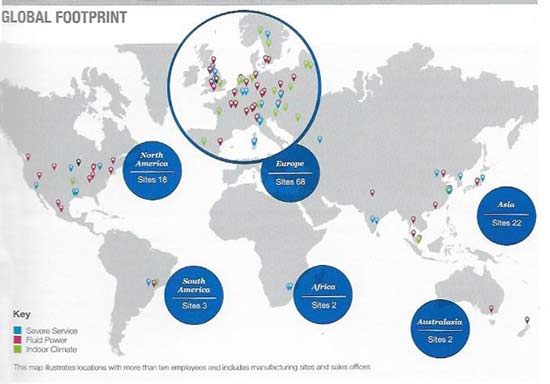 The
Company now operates as three divisions:
Severe Service;
Fluid Power; and
Indoor Climate. The key
brands, main markets and major operational locations
remain essentially as in 2012. (Those for the Beverage
Dispense and Merchandising divisions have disappeared
from the Company's portfolio). This is the Company's
current Global Footprint showing 93 different sites
(right).
The
Company now operates as three divisions:
Severe Service;
Fluid Power; and
Indoor Climate. The key
brands, main markets and major operational locations
remain essentially as in 2012. (Those for the Beverage
Dispense and Merchandising divisions have disappeared
from the Company's portfolio). This is the Company's
current Global Footprint showing 93 different sites
(right).
Revenue for the Company is now £1743m (+3% over last
year) and profit before tax £297.7m (+8%).
2014
The review of activities identifies the need for greater
investment in product development; better Company-wide
collaboration and coordination (IT systems and
facilities); improved organisational structure; greater
concentration on those existing markets where the
greatest potential for growth and profit exists; and an
expansion, via acquisition, of addressable markets.
The Company's three divisions are now known as:
-
IMI Critical Engineering
(previously Severe Service), comprising 14 companies
operating in 12 countries.
-
IMI Precision Engineering (previously Fluid
Power), comprising 5 companies with manufacturing
facilities in 8 countries and a presence in 75.
-
IMI Hydronic Engineering
(previously Indoor Climate), comprising 4 companies
manufacturing in 6 countries
In the course of the
year the IMI Components manufacturing site in Birmingham
is closed following a drop in demand in the nuclear fuel
enrichment market; and the Eley businesses are sold for
£42m. Bopp & Reuther, the German power generation valve
specialist, is acquired for £153m. and becomes part of
the Critical Engineering Division.
Revenue for 2014 is £1686m and profit
£278.1m.
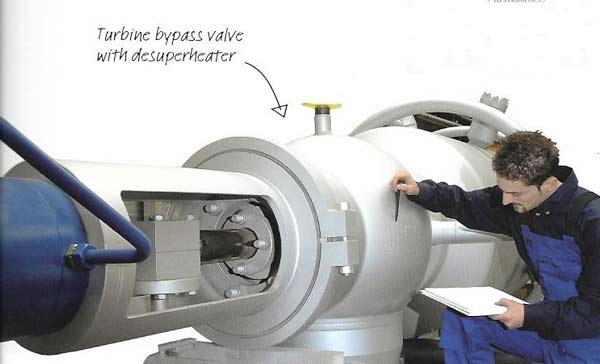
One of Critical Engineering's
impressive products:
2015
 Worldwide economic conditions are difficult, with
special problems in China and Brazil. This affects
the Company's activities and performance. Some
contraction of manufacturing capacity is made, although
Critical Engineering complete three larger manufacturing
sites in Houston, Italy and Korea (the latter for IMI
CCI at a cost of £8m and pictured left). Company revenue
for the year is £1557m. (-5%) and profit £218.7m.
(-21%).
Worldwide economic conditions are difficult, with
special problems in China and Brazil. This affects
the Company's activities and performance. Some
contraction of manufacturing capacity is made, although
Critical Engineering complete three larger manufacturing
sites in Houston, Italy and Korea (the latter for IMI
CCI at a cost of £8m and pictured left). Company revenue
for the year is £1557m. (-5%) and profit £218.7m.
(-21%).
New
data management, project management and
 quality systems
are being introduced throughout the divisions. This is
an ongoing plan and will continue for a long period,
across all the sites. R&D expenditure is increasing,
currently 3% of revenue with the target of 5% by 2017.
Critical Engineering have successfully integrated Bopp &
Reuther into their activities. New products are
introduced, especially in Hydronic Engineering where
some 29 have appeared since 2014. They include
"Eclipse", a next-generation automatic thermostatic
radiator valve which sells 500,000 units in the first
five months after introduction, compared with 100,000 by
its predecessor throughout its entire product life.
Precision Engineering are working on a new Industrial
Automation product range to be introduced in late 2016.
quality systems
are being introduced throughout the divisions. This is
an ongoing plan and will continue for a long period,
across all the sites. R&D expenditure is increasing,
currently 3% of revenue with the target of 5% by 2017.
Critical Engineering have successfully integrated Bopp &
Reuther into their activities. New products are
introduced, especially in Hydronic Engineering where
some 29 have appeared since 2014. They include
"Eclipse", a next-generation automatic thermostatic
radiator valve which sells 500,000 units in the first
five months after introduction, compared with 100,000 by
its predecessor throughout its entire product life.
Precision Engineering are working on a new Industrial
Automation product range to be introduced in late 2016.
IMI Scott and IMI Z&J South Africa are disposed
of as non-core businesses.
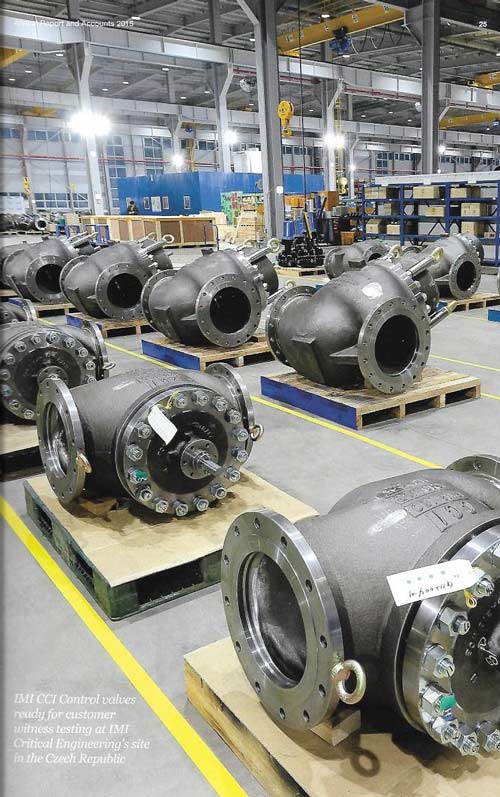
Here
(right)
is a batch of IMI CCI control valves at C.E.'s site in
the Czech Republic.
2016
Market conditions remain tough but results
are in accordance with expectations: revenue £1649m.
(-5%) and profit £208m. (-5%). Because of these market
difficulties, eight, lower growth and higher cost Critical
Engineering sites have been sold or closed and
othercost-cutting measures have been adopted throughout
the Company. In C.E a loss-making Italian service
business is sold. However, confidence in the plans to
develop the business remains strong.
This is a
summary of the market sectors in which the three
divisions are active and the products supplied:
CRITICAL ENGINEERING:
Power
Generation (turbine bypass valves);
Oil and Gas
(anti-surge valve and actuator systems for LNG
compression facilities); Petrochemical (integrated flow
control systems in Fluid Catalytic Cracking, bespoke
valves for ethylene, polypropylene and delayed coking
production processes); Actuation (complete actuation
systems to operate industrial valves for demanding
applications and processes).
PRECISION
ENGINEERING:
 Industrial Automation (high
performance valves, valve islands, proportional and
pressure monitoring controls, air preparation products
and pneumatic actuators); Commercial Vehicle (chassis
and powertrain solutions which deliver fuel efficiency,
emissions reduction and faster assembly times for
commercial vehicle manufacturers);
Oil and Gas (harsh
environment precision control products including
stainless steel valves and regulators, nuclear class
valves and emergency shutdown controls);
Life Sciences
(precision flow control solutions used in medical
devices, diagnostic equipment and biotech and analytical
instruments).
Industrial Automation (high
performance valves, valve islands, proportional and
pressure monitoring controls, air preparation products
and pneumatic actuators); Commercial Vehicle (chassis
and powertrain solutions which deliver fuel efficiency,
emissions reduction and faster assembly times for
commercial vehicle manufacturers);
Oil and Gas (harsh
environment precision control products including
stainless steel valves and regulators, nuclear class
valves and emergency shutdown controls);
Life Sciences
(precision flow control solutions used in medical
devices, diagnostic equipment and biotech and analytical
instruments).
Precision Engineering's customers now only
have to use an App if they need a repacement part in a
hurry, whether it's to repace an IMI part or a
competitor's. Scan the part no. or photograph the item and
up will come ordering details
(above left).
HYDRONIC ENGINEERING:
Balancing and Control (balancing and control systems to
keep comfort in buildings at the right level and to
increase efficiency levels); Thermostatic Control
(thermostatic control systems guaranteeing direct or
automatic control of radiators and underfloor heating
systems); Pressurisation (range of pressure maintenance
systems with compressors or pumps and expansion vessels
to maintain the correct pressure in heating, cooling and
solar systems); Water Quality (dirt and air separators
and pressure-step degassers to protect hydronic systems
by keeping water free of micro-bubbles and sludge).
2017
The Company now employs some 10647 people in over 50
countries, distributed as follows: U.K. 1265;
Continental Europe 5872; Americas 2100; Asia Pacific
1193; and Rest of the World 27. Some 160
subsidiary undertakings/Companies are listed in the
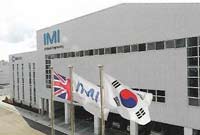
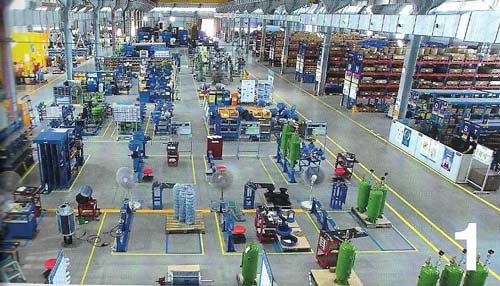
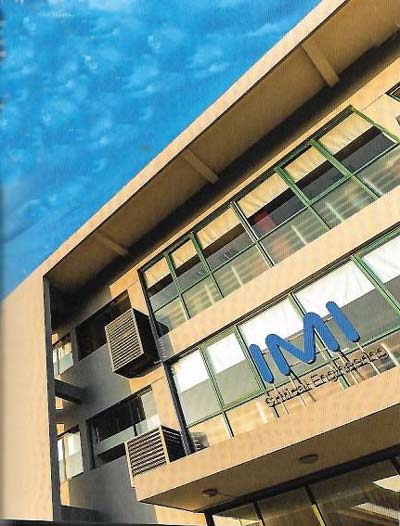
Annual Report. This is a view of the Company's new
Korean facility:
Reflecting the
international nature of IMI's business, the nationality
of the Board of Directors is currently British (3);
American and American/British (2), Australian (1);
German (1); and Danish (1). The Chairman is Lord Smith
of Kelvin and the Chief Executive, Mark Selway.
Trading conditions in the last
year have been mixed: Precision Engineering's markets
grow strongly, the Automation and Commercial vehicle
markets strengthen, the European construction markets
are slightly stronger and in North America and China
construction markets continue to grow; to offset these
movements, the Power Generation sector suffers from
lower investment and the energy market continues to be
soft. Meanwhile the Oil and Gas market starts to
stabilise. These somewhat improved conditions and also
 continuing efficiency improvements (including new IT
systems throughout the organisation and the closure of
12 Critical Engineering higher-cost sites) lead to an
improved financial outcome: revenue £1751m. (+6%) and
profit £224m (+8%).
continuing efficiency improvements (including new IT
systems throughout the organisation and the closure of
12 Critical Engineering higher-cost sites) lead to an
improved financial outcome: revenue £1751m. (+6%) and
profit £224m (+8%).
Many new products are
introduced (including 13 in Hydronic Engineering) and
ambitious product development strategies are being
pursued in each of the three divisions. The Company
acquires Bimba Manufacturing, a market leading supplier
of pneumatic, hydraulic and electric motion products to
the North American Industrial Automation market, at a
cost of £138m.; it is based in Illinois. The sale of the
loss-making UK fasteners business, Stainless Steel
Fasteners, is announced. A new Critical Engineering
facility is opened in Qinpu, China
(right).
2018
As the Company enters the final year of its
Development Plan initiated in 2013, its financial
results show continuing improvement: revenue £1907m.
(+5%), profit £251m. (+12%). Trading conditions
nevertheless continue to be mixed, with, in particular,
a decline in the Fossil Power and Energy markets. UK
sales now amount to less than 5% of total revenue but nevertheless the
Company has felt it necessary to develop a number of
Brexit-related contingency plans to offset future
problems; these include increased inventories. The
Company is actively and successfully managing its
pension liabilities.
Bimba is being successfully
integrated into Precision Engineering's North American
operations and it is expected that the
introduction of various improvements in operation and
systems will lead to improvements in sales and profit.
In the same division the Indian operation
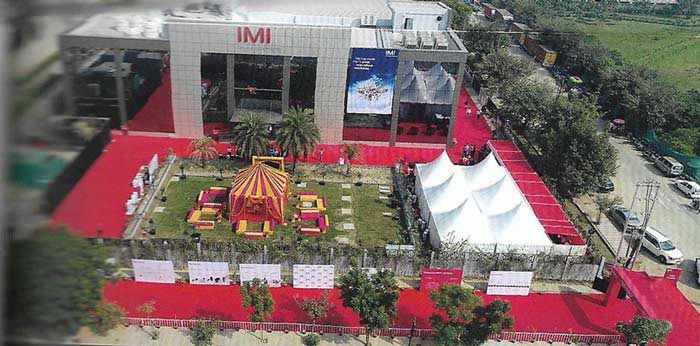 has been
relocated into a new and larger facility in New Delhi,
thus expanding its low-cost, world-class manufacturing
and engineering capability and enhancing the Company's
ability to serve its rapidly expanding market across
Asia. It is located in Noida, near New Delhi
(right). On the other hand Critical Engineering have had to
undertake several plant closures, now successfully
completed.
has been
relocated into a new and larger facility in New Delhi,
thus expanding its low-cost, world-class manufacturing
and engineering capability and enhancing the Company's
ability to serve its rapidly expanding market across
Asia. It is located in Noida, near New Delhi
(right). On the other hand Critical Engineering have had to
undertake several plant closures, now successfully
completed.
New products continue to be
introduced across the entire Group. In Hydronic
Engineering new product launches continue apace and
sales of recently introduced products now amount to 22%
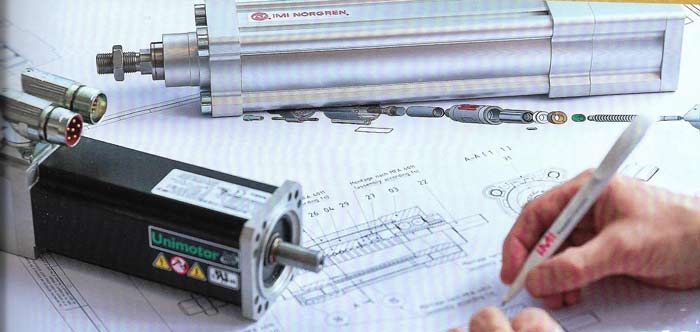
of total sales in that division. This is the new
electric actuator developed by IMI Norgren which will be
launched in 2019.

Text
© staffshomeguard.co.uk 2007-2019
Images © IMI plc 2002-2019
v2.5 - 16th May 2019

 STAFFS
HOME GUARD WEBSITE - MISC. INFORMATION
STAFFS
HOME GUARD WEBSITE - MISC. INFORMATION

