HOME GUARD MEMORIES AND INFORMATION - WARWICKSHIRE
THE 25th WARKS (B'HAM) BATTN. and
M. B. WILD & CO. LTD. and THE POPPITT FAMILY
THE L.H. NEWTON & CO. AIR RAID
This is a page within the www.staffshomeguard.co.uk website. To see full contents, go to SITE MAP.
|
Lt. Col. Walker, C.O. of the 25th Warwickshire (Birmingham) Battalion Home Guard, writing in early 1943, describes a particularly serious air raid incident as follows:
The Battalion is situated in a vulnerable area, and during the 'blitzes' of 1940 did exceptionally good work in fire-fighting and evacuation of civilians from damaged areas and threatened shelters. On one particular occasion over three hundred were moved from beneath a burning building to other shelters three hundred yards away, without loss to the civilians. Two men were killed and two wounded in this process. |
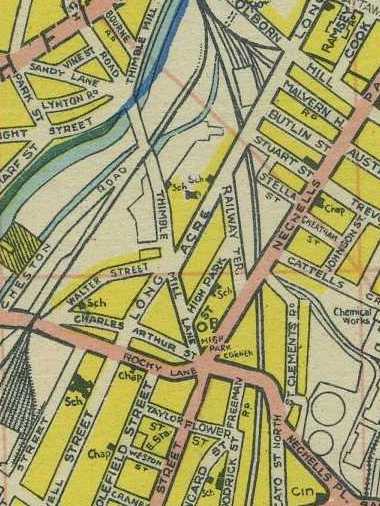 Whilst for reasons of national security the location of this incident could not be mentioned at the time, it occurred at the premises of L. H. Newton & Co. Ltd. of Thimble Mill Lane, Nechells, manufacturers of nuts, bolts and screws; and during the night of 9th/10th April 1941. Whilst for reasons of national security the location of this incident could not be mentioned at the time, it occurred at the premises of L. H. Newton & Co. Ltd. of Thimble Mill Lane, Nechells, manufacturers of nuts, bolts and screws; and during the night of 9th/10th April 1941.
It was a major incident and prompted acts of remarkable individual bravery leading to high awards.
William Wilfred Bennett, an auxiliary fireman of Birmingham Auxiliary Fire Service received the George Medal and and his colleague James Henry Meers the British Empire Medal (Civil Division). Sgt. Philip H. Bermingham of the 25th Battalion received the King's Commendation for Bravery.
The London Gazette of 29th August 1941 provides us with some detail of what occurred.
During an air raid, Auxiliary Firemen Meers and Bennett were on duty at a Sub-Station on Works premises when it was wrecked and set on fire by a H.E. bomb. A man on the second floor was blown by the blast across an exposed girder where he was in grave danger of being burnt to death. Meers and Bennett, although badly shaken by the explosion, at once attempted to rescue him. Bennett, by climbing a girder, reached the victim and, with the help of Meers, brought the injured man to safety.
The fire spread rapidly and it was necessary to evacuate a basement shelter. Despite the intense heat and dense smoke, Meers and Bennett helped to remove the occupants, some of whom were injured. Later, hearing cries for help they re-entered the basement and guided two men to safety. They then rejoined their A.F.S. colleagues and tackled the fire.
Bennett showed great courage and initiative and was ably assisted by Meers.
|
Sgt. Bermingham was a member of the Works Home Guard unit. His award was in recognition of his role in the evacuation of employees from the factory and the subsequent recovery, in conditions of extreme danger, of the unit's stock of rifles and ammunition.
Subsequent research into the events of that night, in particular that carried out by the author of "Heroes of the Birmingham Air Raids", Mr. Michael Minton, reveals that the factory had already been hit by a number of incendiaries and was well on fire before a High Explosive bomb landed on the building, pierced all four floors and exploded on the ground floor exposing part of the basement. The latter was a large shelter containing some 400 people, some of them injured. The spread of the fire made the basement's evacuation necessary. This situation led to the three particular acts of heroism which were later recognised and no doubt to many other people, members of A.F.S., A.R.P., Police and Home Guard or just ordinary members of the public, also risking their lives.
The terrifying night of 9th/10th April 1941 led to death and injury to many people throughout the Nechells area and much destruction. Men, women and children lost their lives in Bloomsbury Street, Freeman Road, Oliver Street, Nechells Park Road, Goodwin Terrace, Clevedon Street, Trevor Street, Addison Road, Chattaway Street, Aston Church Road, Thimble Mill Lane and Cromwell Street. Among them were
Albert Caine, aged 16, at L.H. Newton & Co.; and two women also in Thimble Mill Lane, at No. 307,
Gladys Annie Millward, 22, and
Mary Millward, 73. (It is not clear to precisely which casualties Col. Walker is referring in his report). One person who survived, together with his family, was Bob Steele who now lives in Adelaide. He has written about that night and generously given his permission for his words to be recorded here.
|
Bob Steele's memory
I was there when L. H. Newton was bombed. Not in the factory but in an air raid shelter in Long Acre right next door to Newton's. We lived in the second back yard from Newton's but Mom went from our house down the entry to the street and along to the back yard right next to the factory.
I was 22 months old when Dad was handing me down to Mom when the bomb hit. Dad chucked me down to Mom and then dived in himself. (Do I remember all that happening or did Mom tell me about it and it stuck in my memory?) 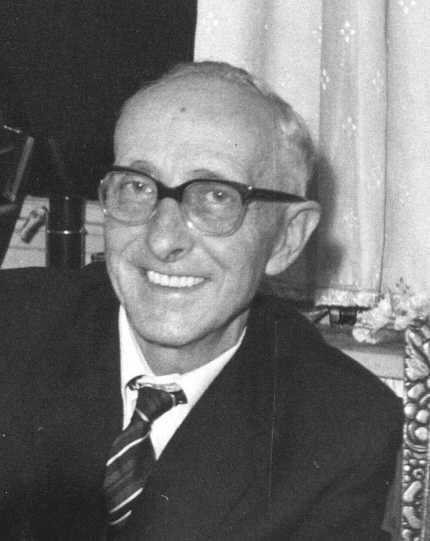 The shelter was one of those dug into the ground and with corrugated iron as a roof. The shelter was one of those dug into the ground and with corrugated iron as a roof.
Also on that night an incendiary bomb came down the side of Newton's and down the chimney of the brew-house but didn't go off.
My dad (seen right in later life) was 33 at the time and he was in the Home Guard. He was a small person and I believe he was working at Wild's factory inside the tanks. And do I remember him telling me of walking down Long Acre one day when a German plane came over and taking a shot at it with his rifle?
|
Despite the destruction of its manufacturing facilities in Nechells, production by Newtons was resumed with as little delay as possible at a factory in Tamworth. After the war the Birmingham factory was rebuilt and production transferred back there. Many of the postwar employees had homes in Tamworth and so a works bus service was instituted to bring them into Birmingham every morning and return them in the evening. This continued for many years and was still operating in the mid-1970s.
But returning to the events of 1941... To us, reading about those days of seventy years ago, most of the people involved are just names, statistics even, and the streets where they lived and worked are now wholly transformed. In the comfort and relative security of the 21st century we skip through text such as this, think about it for a moment, or less, and move on to something else. Perhaps, though, we should pause for a few seconds longer and ponder just what those times were like for the people who lived through them, and for some who didn't. What WAS it like? Like this, perhaps?
ACKNOWLEDGEMENTS
We make grateful acknowledgement to Bob Steele of Adelaide, Australia; CB of Canada for his postwar memories; "The Home Guard of Britain" by Charles Graves, Hutchinson & Co., 1943; "Colin B" of the birminghamhistory forum; "Heroes of the Birmingham Air Raids" by Michael Minton; the excellent Swanshurst School/BARRA website; The London Gazette; and various other internet resources.
x38A
|
|